
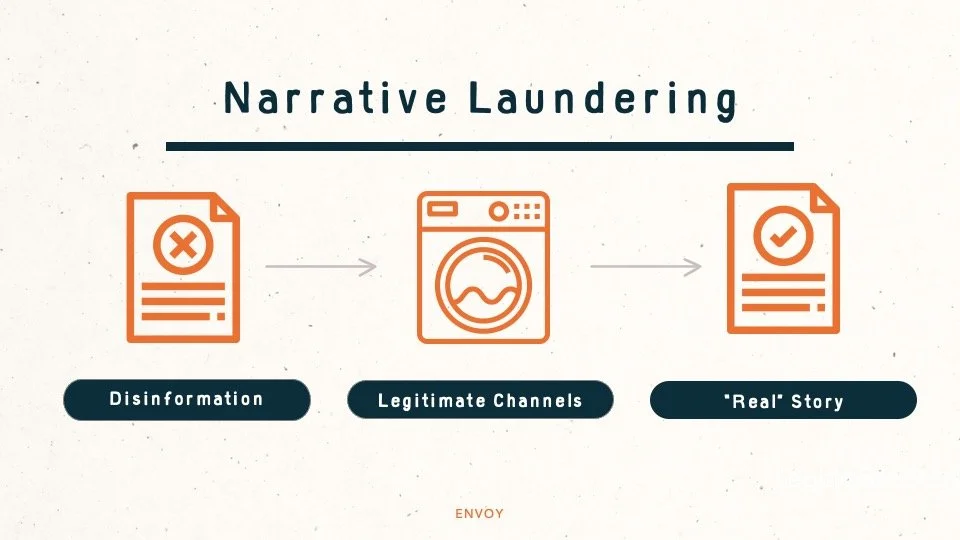
As we spend increasing time with clients addressing fake narratives, a reminder of the terminology:
Malinformation: Information about you that’s negative, but true. Often used out of context to increase sense of negativity around your character.
Misinformation: Information that is shared, but unknowingly incorrect.
Disinformation: False and misleading information calculatedly spread, often as part of a campaign.
To launder disinformation (to make it appear credible), an operator will dangle the fake information adjacent to a legitimate commentator that wishes it to be true. Confirmation bias leads the commentator to repeat the statement (often taking credit for the information as if they’re the original source). Legitimate parties around that target then trust them as a source and repost and magnify until it becomes background noise to the issue and starts to influence decision makers.
A sophisticated operation will combine offline efforts - posters, postcards, stickers - even events - to reinforce the fake narrative.
We often associate disinformation campaigns with global politics, but can be used as much on local issues (planning, conservation, law enforcement) or internal company strategy and reorganizations.